

Spot and area machine lighting serve different purposes. A spot light creates intense light in a precisely selected direction. An area or linear light illuminates more of the work space and reduces deep shadows. On large machines, combining both often gives the best result.
When to use a spot machine light
A spot light is suitable when you need to highlight a tool, cutting edge, measurement point or a specific area of the workpiece. Correct position and adjustability are essential. A flexible gooseneck is quick to reposition, a metal joint holds a compact position and an articulated arm provides the greatest reach.
- lathes and milling machines where detail at the cutting point is important;
- drill presses, grinders, presses and assembly stations;
- surface inspection, measurement or tool setting;
- supplementary light for the machine area lighting.
When to choose an area or linear light
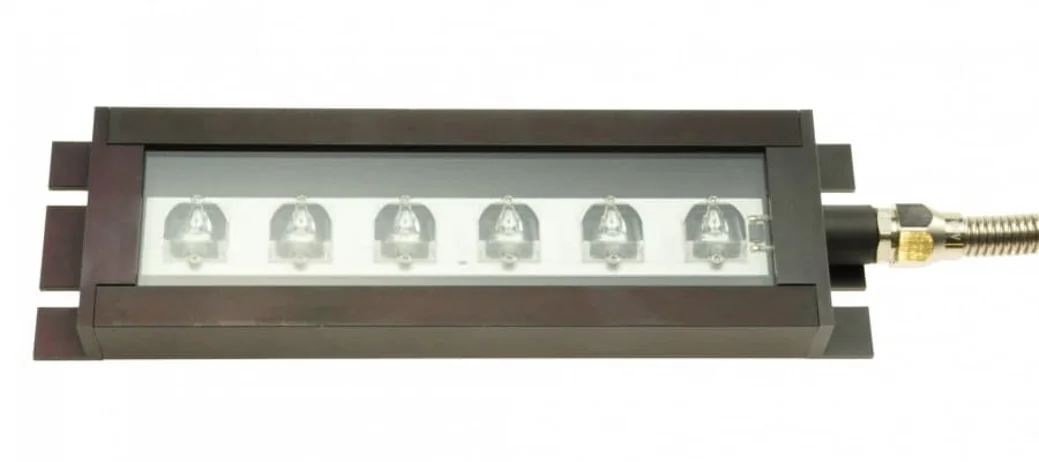
Area machine lights are useful in enclosed CNC machines, long work spaces and production lines. A wide field reduces contrast between bright and dark areas. A linear design also distributes light sources along the complete work zone.
| Feature | Spot light | Area / linear light |
|---|---|---|
| Primary purpose | Intense light on detail | Uniform area lighting |
| Shadows | More pronounced, direction-dependent | Softer and less pronounced |
| Positioning | Gooseneck, joint or arm | Usually fixed installation |
| Typical use | Tool, workpiece, inspection | Entire CNC or production-line work space |
Combining both types is often best
One area light can provide good general lighting, while a separate spot light adds intensity at the tool. This reduces shadows and allows the operator to adapt the lighting to each operation.
What to compare before selecting
- Work-area dimensions and distance from the light to the workpiece.
- Locations affected by doors, guards, the tool head or coolant flow.
- Required uniformity and the risk of glare to the operator.
- Supply voltage, protection rating and mounting method.
- Photometric maps in lux, not only total luminous flux in lumens.