
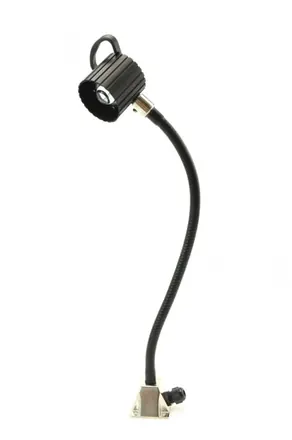
Choosing between a 24 V machine light and a 230 V version is not simply a matter of light output. The same light head may be offered in both versions and perform almost identically. The decisive factors are the machine electrical system, installation method and available space for a driver or transformer.
24 V machine light: when low voltage is already available
A 24 V version is usually the simplest choice when the machine already has a suitable low-voltage supply. The light can be smaller because no transformer is required in the base. This is especially useful inside an enclosed machine or where space is restricted.
First verify the actual voltage and whether it is AC or DC. Some lights accept both AC and DC over a wide range, while others have a narrower range. A “24 V” label alone is not enough; compare it with the technical specifications of the selected light.
Advantages of 24 V
Smaller base, easy use of the machine supply and a wide choice of gooseneck, joint and articulated-arm versions.
Points to check
Check AC/DC, the actual voltage range, available supply power and circuit protection. The 24 V label alone is not sufficient.
230 V machine light: a complete solution with transformer
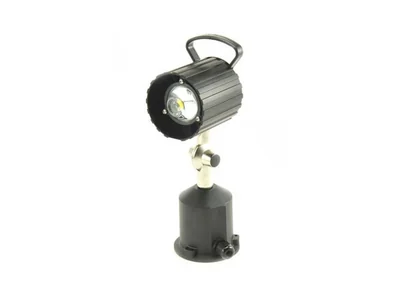
A 230 V version is suitable when the machine has no usable low-voltage output or when a self-contained complete light is preferred. In our spot lights, the transformer is located in the base, allowing direct connection to the mains supply.
The simpler electrical connection requires a larger base and a more fixed configuration. During installation planning, check not only the head and arm dimensions but also space for the transformer housing and supply cable.
| Question | 24 V | 230 V |
|---|---|---|
| Is a suitable voltage already available in the machine? | Yes, usually the simplest solution | Not required |
| Base size | Smaller base | Larger housing with transformer |
| Light output | Depends on the selected model | Can be the same as the 24 V version |
| Typical installation | New machine or use of an existing supply | Retrofit without a suitable low-voltage supply |
Selection procedure
- Measure or verify the voltage available on the machine and determine whether it is AC or DC.
- Determine the required luminous flux and work-area size.
- Select the positioning method: flexible gooseneck, compact joint or articulated arm.
- Check ingress protection, ambient temperature and exposure to coolant or oil.
- Compare the mounting space required for a 24 V base and a 230 V transformer base.
Choose by machine supply
Both categories include compact and high-output lights with several mounting options.