
When replacing an old halogen light on a lathe, milling machine or other equipment, wattage alone is not enough. LED lights have different efficiency, light distribution and thermal behaviour. Select the replacement according to supply voltage, required illuminance, mounting location and operating environment.
1. Identify the supply voltage of the original light
Older machine lights may be supplied from the mains, a machine transformer or a less common voltage. Verify the voltage by measurement or documentation. If the machine has a suitable 24 V supply, a smaller low-voltage light can usually be used; otherwise a complete 230 V version with transformer in the base is simpler.
2. Do not confuse watts with light output
Power input tells you how much electrical energy the light uses. Luminous flux in lumens and, above all, illuminance in lux at the workplace are more important for selection. Narrow optics can produce higher detail illuminance from fewer lumens than a wide light with higher total output.
| Work-area size | Recommended type | Example |
|---|---|---|
| Small machine or detail | Compact light with flexible gooseneck | DeskLED, 460 lm |
| General lathe, milling machine or press | Spot light with selectable optics | InLED, 1,500 lm |
| Large machine tool | High-output spot light | NewRefLED, 3,500 lm |
| Entire enclosed work space | Area or linear light | BendLED, S020 LED, LeanLED |
3. Choose the mounting method according to operator needs
- Flexible gooseneck is quick to reposition and suits frequent changes.
- Metal joint is compact and holds the selected direction firmly.
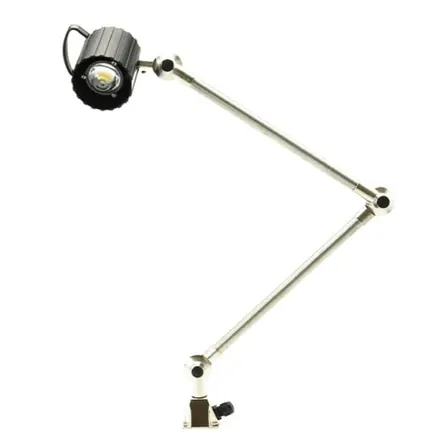
- Articulated arm provides the greatest reach over the work area.
- Fixed area light is best for stable lighting of the entire work space.
4. Check protection and materials
Inside a machine tool, the light is exposed to coolant, oil, metal chips and vibration. Its construction must suit the actual installation location. A high IP rating is important, but chemical resistance must be assessed separately.
5. Compare photometry before installation
Illuminance maps and EULUMDAT data help estimate whether the selected light will cover the work area from the planned distance. For machine lighting, this is far more useful than a product photograph alone.