
The same luminous flux can produce very different results. Narrow optics concentrate light onto a small area and achieve high illuminance. Wide optics distribute light over a large area, but maximum lux is lower. Selection cannot be based on lumens alone.

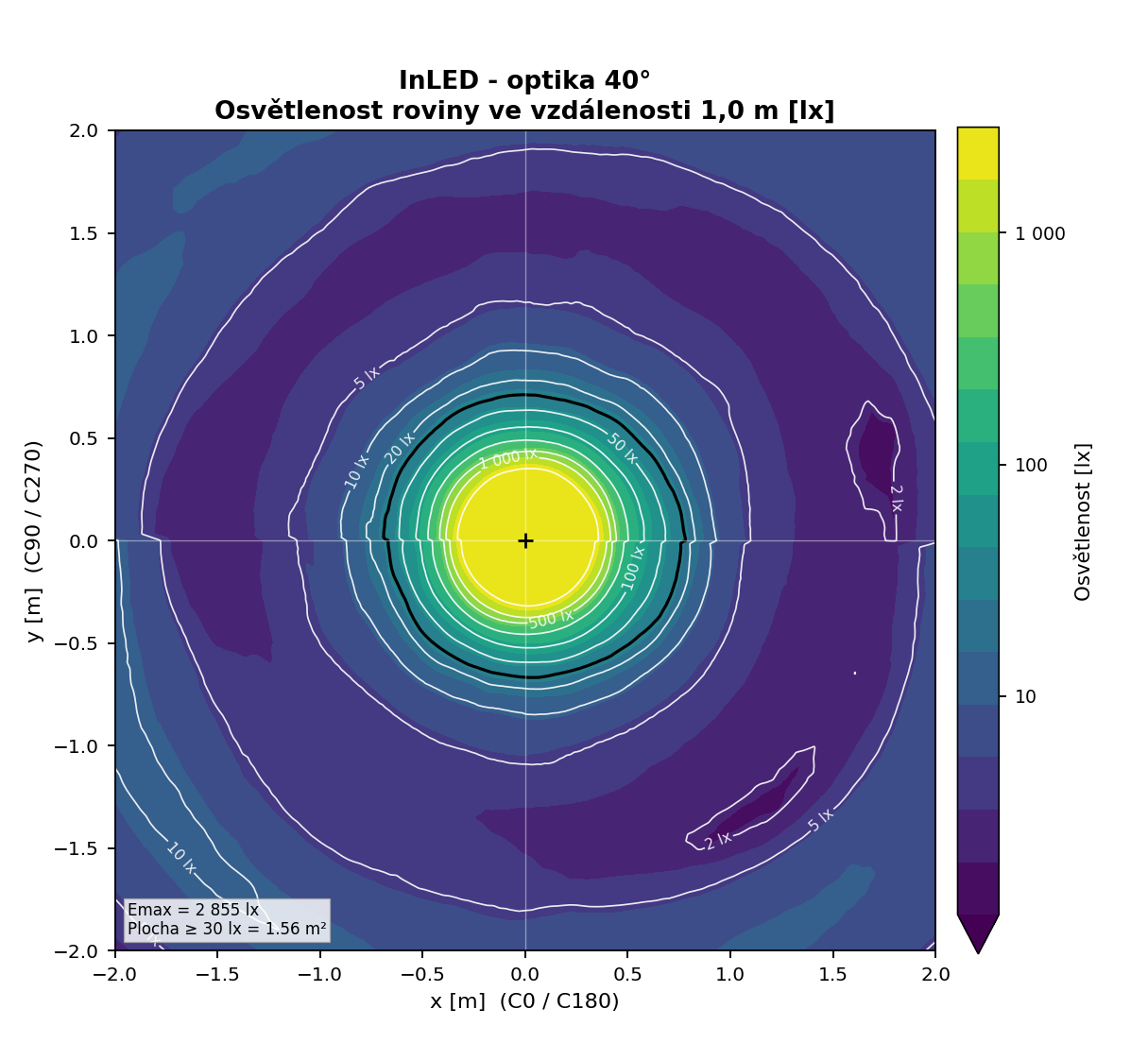

The maps above use the same InLED head with 1,500 lm and are calculated for a plane 1 m away. The difference is therefore primarily caused by the optics.
| Optics | Typical effect | Suitable use | Emax at 1 m |
|---|---|---|---|
| 16° | Narrow, intense beam | Detail, greater distance, tool | approximately 7,821 lx |
| 40° | Versatile spot light | General machining and assembly workstations | approximately 2,855 lx |
| 120° | Very wide light field | Short distance and large area | approximately 155 lx |
16° optics: detail or greater working distance
The narrow beam is suitable when the light is farther from the workpiece or a small area needs intense illumination. It requires more precise aiming and may create too small a bright spot at short distance.
40° optics: the versatile choice
The 40° optics are usually the best-balanced choice for general machine workstations. They provide sufficient intensity while illuminating the area around the tool. Suitable for most lathes, milling machines, drill presses and assembly stations.
120° optics: wide area from a short distance
Wide optics suit applications where the light head is close to the work area and sharp transitions between light and shadow should be reduced. They are not intended for intense lighting of a small detail from a long distance.